Fantasy Stickers Help Kids Build Real Skills
Imaginative play builds empathy, creativity, and problem-solving. Personalised fantasy stickers turn your child into the character, not just a spectator.
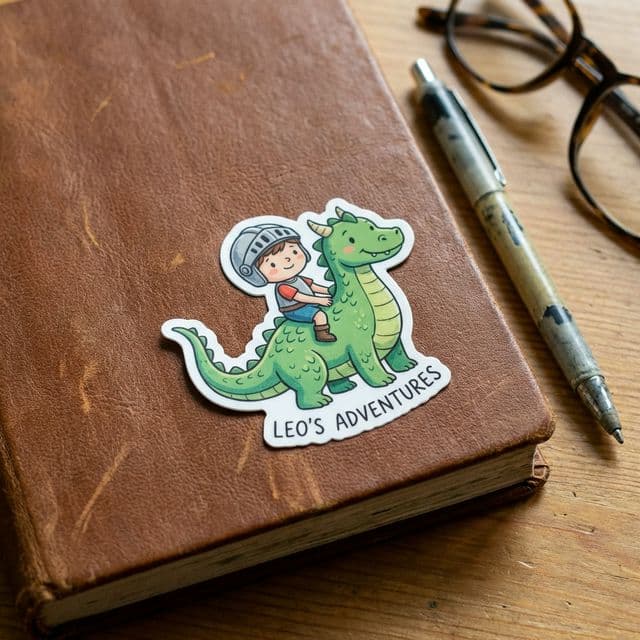
Imaginative Play Is Not a Nice-to-Have
I used to think my daughter's fairy obsession was cute but ultimately pointless. She'd spend an hour narrating an elaborate story to a stick she'd named Queen Fernleaf. I'd smile, nod, and quietly wonder when she'd move on to something more, well, useful.
Then I started reading the research. And I changed my mind completely.
Studies consistently show that imaginative play builds empathy, creativity, and problem-solving skills in children. A 2025 study published in the Journal of Research in Childhood Education found that pretend play provides a developmentally appropriate context for children to explore emotions, practise perspective-taking, and develop social competence. Researchers have also linked fantasy play to enhanced cognitive flexibility, meaning kids who pretend are better at adapting their thinking to new situations.
This isn't fringe science. This is decades of evidence pointing to the same conclusion: when your child pretends to be a wizard or a dragon rider, they're doing some of the most important developmental work of their childhood.
Why Fantasy Play Matters More Than We Think
When a child takes on a fantasy role, they're not just playing. They're practising being someone else. That's the foundation of empathy.
A kid who pretends to be a fairy rescuing a trapped creature is working through a moral scenario. Who needs help? How do I help them? What would it feel like to be trapped? These are sophisticated cognitive tasks dressed up as play, and children do them instinctively when given the space.
Fantasy play also builds narrative thinking. Your child is constructing stories with beginnings, middles, and ends. They're assigning motivations to characters. They're solving problems within the rules of a world they invented. That's creative problem-solving in its purest form.
And here's what worries me: kids are getting less time for this kind of play. Research shows that children lost roughly 12 hours of free time per week between 1981 and 2003, and the decline has continued since. More structured activities, more screen time, less unstructured pretend play. The space where imagination thrives is shrinking.
From Watching Fantasy to Living It
Most kids consume fantasy through screens. They watch animated wizards and dragon riders. That's fine, but it's passive. The developmental benefits come from active fantasy play, where the child is the character making decisions and driving the story.
This is where personalised fantasy stickers for kids do something genuinely interesting. When your child sees a sticker of themselves as a dragon rider soaring over mountains, they're not looking at a character. They're looking at themselves as the character. That's identity play.
Identity play is powerful. It's the difference between watching a hero and believing you could be one. A child who sees their own face in a fantasy scene carries that sense of capability into their real life. It's the same principle behind children's books that let kids insert their own name into the story, except a sticker lives on their drink bottle, their bedroom door, their school folder. It's a constant, tangible reminder.
Two Scenes That Spark the Best Play
Dragon Rider puts your child on the back of a friendly dragon above a mountain landscape. It appeals to an enormous age range. Four-year-olds love it because dragons are inherently magnificent. Ten-year-olds love it because it looks like the cover of a book they'd actually read. The scene is adventurous without being scary, which matters for younger kids.
Fairy Garden places your child in a dreamy, enchanted garden with wings and soft light. It's gentler, more contemplative. This one tends to spark quieter, more narrative-driven play. Kids who gravitate toward Fairy Garden are often the ones building elaborate story worlds in their heads.
Both scenes work beautifully as starting points for imaginative play. The sticker becomes a character card, a visual anchor for the stories your child tells.
The Sticker as a Play Object
I've watched my daughter use her fairy sticker in ways I didn't expect. It went on her journal, and suddenly the journal became a spellbook. It went on her drink bottle, and she told me the water was a magic potion. The sticker didn't just decorate her stuff. It transformed it.
Other parents have told me similar things. A dragon rider sticker on a bedroom door turns the room into a lair. A fairy sticker on a lunchbox turns lunch into a feast in an enchanted forest. Kids are remarkably good at building worlds from small prompts, and a personalised sticker is one of the most effective prompts I've seen.
This is what the research means when it talks about props supporting pretend play. A sticker of your child as a fantasy character is a prop that says: this world is yours, and you belong in it.
Not Just a Phase Worth Tolerating
We tend to talk about kids' fantasy phases with an air of amused tolerance. "Oh, she's in her fairy phase." As if it's something to get through.
I'd argue it's something to invest in. The empathy your child practises during fantasy play will serve them in every friendship, every classroom, every workplace they'll ever be in. The creative thinking they develop while narrating elaborate dragon adventures will help them solve problems that haven't been invented yet.
A personalised fantasy sticker costs less than a picture book. But it does something a picture book can't: it puts your child at the centre of the story. Not as a reader, but as the hero.
If your child is in a fantasy phase right now, lean into it. Give them props. Give them permission. Give them a sticker of themselves as the character they most want to be. The developmental payoff is real, even if the dragon isn't.
For kids who love seeing themselves as characters across different themes, a fantasy sticker is one of the most natural fits. And if your little one's interests extend beyond fantasy into outdoor adventures, helmet stickers can carry that same sense of identity into the real world. You can design a sticker on StickerMe in about two minutes.
Peel off another one
How to Print ChatGPT Stickers in Australia
You made stickers in ChatGPT and now you want them on a drink bottle. What actually stands between a generated image and a real peel-off sticker.
Read article
Personalised School Labels Kids Can Recognise
A practical guide to personalised school labels: what to label, which sticker size fits where, and how one familiar character helps kids spot their gear.
Read article
The Lunchbox Label Your Kid Will Actually Be Proud Of
Plain name labels are boring and kids ignore them. A personalised illustrated lunchbox sticker does identification and pride in one go.
Read articleWant to make one?
Upload a photo, pick a scene, and see what our agents come up with. Accounts include free weekly generation credits, and printing is charged only when you order.